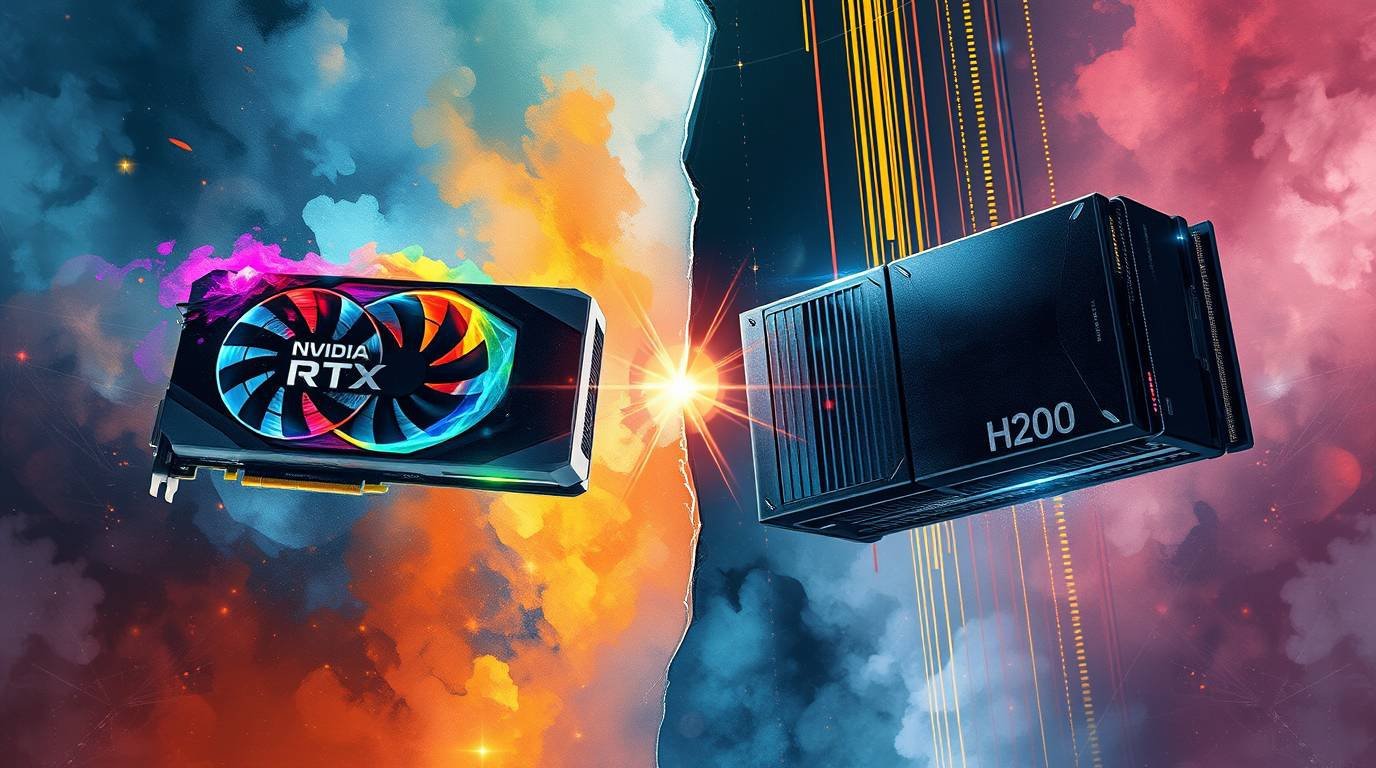
A typical GPU functions as a graphical problem solver, engineered for swift frame rendering and effective management of textures and lighting, which enhances gaming experiences. Although it can handle parallel calculations, its hardware is predominantly graphic-focused, which hinders performance for handling massive non-graphic data sets. In high-demand scenarios or when several units operate simultaneously, this structure can become a limitation, leading to wasted energy and time.
On the other hand, NVIDIA’s specialized accelerators are optimized for calculation tasks. By eliminating unnecessary graphical features, they improve memory bandwidth and enable efficient teamwork among multiple chips, leading to better performance in managing heavy workloads without interruptions.
The H100 and H200 accelerators are powerful computing units designed for extensive mathematical problem solving that require high speed and coordination. Their advanced memory systems deliver greater data throughput than standard gaming cards, considerably cutting down idle time during heavy calculations. Additionally, the H100 and H200 units accommodate advanced mathematical formats like FP8, enhancing computational efficiency while maintaining precision.
For example, an array of H100 units showcases its effectiveness; high-speed connectors allow several cards to function together as one processor. This design is crucial for tasks that surpass the capacity of a single machine, highlighting the importance of scalable solutions beyond simple raw power. In conclusion, the H100 is intentionally designed for sectors and laboratories with high computational needs, where efficiency results in considerable resource savings.
Various types of hardware cater to differing computing applications. Most users need GPUs for traditional activities such as gaming, video editing, and other creative tasks. For these functions, a GeForce RTX card is an ideal choice, serving as an economical option for experimenting with AI or small-scale modeling. However, as operational demands rise, the focus shifts from specifications to reliability and scalability.
Delays in personal AI projects may be frustrating, but in professional environments, such slowdowns can have critical consequences. The H100 aims to reduce these inefficiencies, sustaining effectiveness during high-demand periods. Therefore, the choice between a GPU and an accelerator depends on specific needs; casual AI projects can function adequately with GPUs, while those requiring optimal efficiency will benefit from accelerators like the H100 and H200 series.
The ainewsarticles.com article you just read is a brief synopsis; the original article can be found here: Read the Full Article…